Maintenance Guide
5 Signs Your Pool Cage Needs Rescreening (Florida Homeowner's Guide)
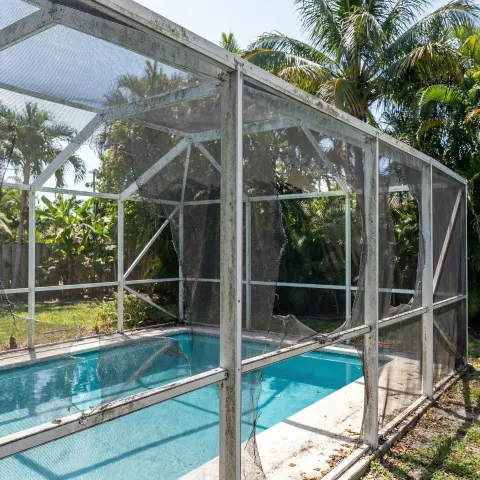
Florida pool cages don't fail all at once — they slowly deteriorate over years, then one panel goes and the rest follow within months. The trick is catching the early warning signs before a small fix becomes a full rescreen. Here are the 5 signs every Florida homeowner should know, plus how to tell if you can get away with a partial repair or if it's time for the full job.
In This Guide
- Why Pool Cage Screens Fail in Florida
- Sign 1: Sagging or Loose Panels
- Sign 2: Visible Holes, Tears, or Punctures
- Sign 3: Hazy, Discolored, or Brittle Mesh
- Sign 4: Spline Coming Loose
- Sign 5: Bug or Lizard Intrusion
- Repair vs. Full Rescreen
- How Long Pool Cage Screens Last in Florida
- Frequently Asked Questions
Why Pool Cage Screens Fail in Florida
Florida is brutal on pool cage mesh. Four things break it down faster than anywhere else in the country:
- UV exposure. Direct subtropical sun cooks the resin coating off fiberglass mesh, turning it brittle. Most mesh starts going hazy after 6–8 years.
- Salt-air corrosion. Coastal and waterfront homes see noticeable mesh degradation in as little as 5 years. Salt eats through the protective coating and the fiberglass strands themselves.
- Tropical storms and high winds. Even sub-hurricane winds (40–60 mph) flex the panels enough to stress the spline grip. Multiple storm seasons add up.
- Wildlife. Lizards, raccoons, squirrels, and the occasional bird leave permanent damage on softer standard mesh.
The result: pool cage screens in Florida typically need rescreening every 8–12 years. Coastal homes are on the shorter end. Hurricane-rated mesh stretches that out to 15+ years.
The 5 Warning Signs
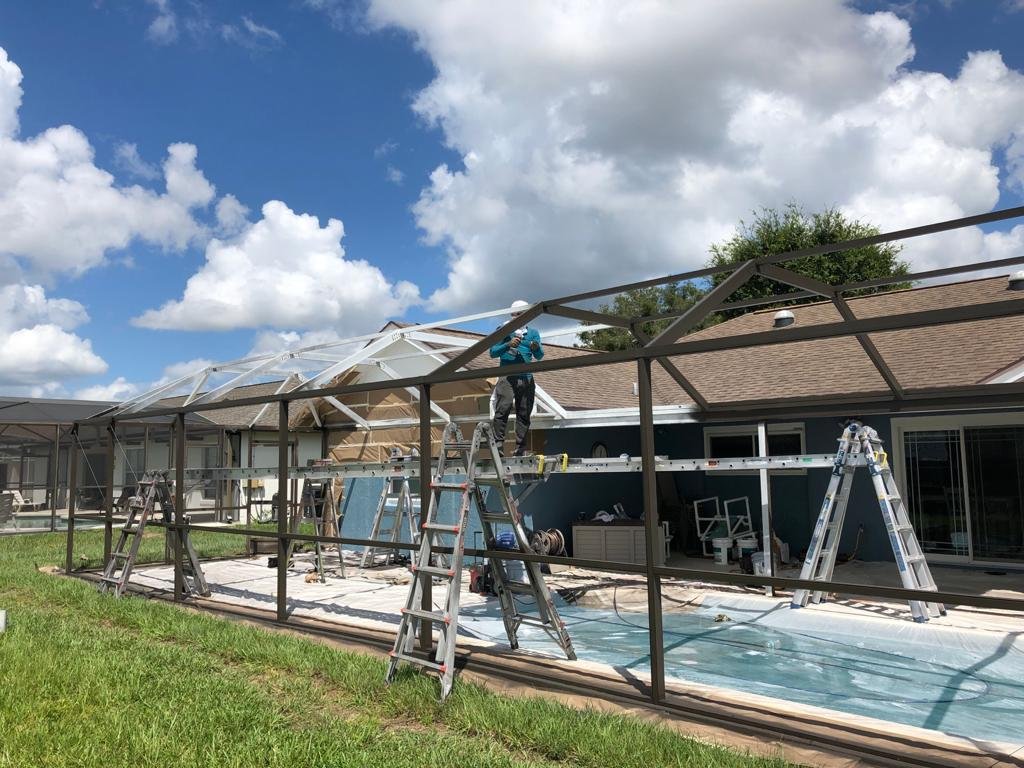
If you spot any of these on your cage, it's time to start thinking about your options. Multiple signs together — especially across more than one panel — usually means a full rescreen is coming.
1
Sagging or Loose Panels
Brand-new screen panels are tight enough to bounce a quarter off. As the mesh ages, it stretches, the spline loses its grip, and the panel starts to billow in light wind — sometimes visibly enough that you can see it move from inside the cage.
What to look for: visible bowing, soft "pillowing" of the mesh under your hand, or a panel that flexes inward more than half an inch when you press it gently. One sagging panel is fixable. Three or more across the cage is a sign the whole mesh is reaching end of life.
2
Visible Holes, Tears, or Punctures
The most obvious sign. Tears can come from storm debris, falling palm fronds, lizard claws, lawn equipment, or just an aging panel that finally gave way. Even tiny pinholes matter — mosquitoes and no-see-ums find them fast.
What to look for: walk the inside perimeter of your cage at midday and look up. Holes show up as bright spots against the dark mesh. Run your eyes across each panel. Anything more than a quarter-inch tear should be patched or rescreened — small holes spread quickly under tension.
3
Hazy, Discolored, or Brittle Mesh
Brand-new charcoal mesh is dark, crisp, and slightly glossy. After years of UV exposure, it goes flat, dusty-looking, and fades toward a chalky gray. The fiberglass strands themselves get brittle — you can sometimes hear them snap when you press the panel.
What to look for: hold a fresh piece of mesh next to an existing panel (any pool supply store has samples). If your existing mesh looks washed out compared to the new sample, the protective coating is breaking down. Once mesh goes brittle, even minor wind events cause new tears.
Not sure how bad it is?
We'll walk your cage and tell you straight — repair or full rescreen.
4
Spline Coming Loose
The spline is the rubber cord that wedges the mesh into the aluminum channel around each panel. After years of sun, it shrinks, hardens, and starts pulling out of the channel — especially at the corners. Once the spline lets go, the mesh has no anchor and the panel sags fast.
What to look for: walk the cage and check the channels around each panel. You should see a clean rubber line pressed firmly into the groove. If you see gaps, lifted spline, or pieces hanging out, that mesh is on borrowed time. Spline can sometimes be re-pressed, but if it's brittle, the only real fix is fresh spline with a fresh panel.
5
Bug or Lizard Intrusion
The whole point of a pool cage is keeping bugs out. If you're seeing mosquitoes, no-see-ums, or lizards inside the cage on a regular basis, the mesh is failing somewhere — even if you can't immediately see where.
What to look for: a sudden uptick in bugs after years of a sealed cage almost always means something has opened up. Common culprits: torn door sweeps, gaps where the mesh meets the frame, hairline tears at panel corners. If you can't find the source, that's also a sign — multiple small failures usually mean the whole cage is past its prime.
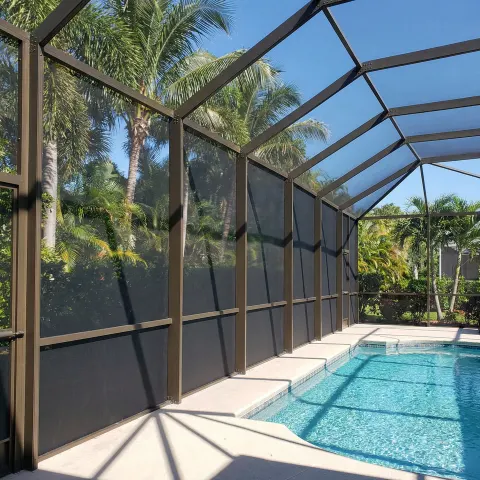
Repair vs. Full Rescreen — Which Do You Need?
Two questions decide it: how many panels show signs, and how old is the mesh overall?
| Your Situation | Recommendation |
|---|---|
| 1–3 damaged panels, mesh under 6 years old | Partial repair — replace just the affected panels |
| 1–3 damaged panels, mesh 8+ years old | Discuss both options. Other panels likely close to failing |
| 4–8 panels showing signs | Full rescreen — per-panel cost flips toward whole-cage |
| Multi-panel sagging + hazy mesh | Full rescreen — the cage is at end of life |
| Door issues + 1–2 panels | Door rescreen + panel patch, no full rescreen needed |
If you want a real number for your specific situation, check our 2026 pool cage rescreening cost guide for typical pricing across Florida.
How Long Pool Cage Screens Last in Florida
Lifespan depends on three things: mesh type, sun exposure, and proximity to the coast.
| Mesh Type | Inland Florida | Coastal / Waterfront |
|---|---|---|
| Standard 18×14 charcoal | 10–12 years | 6–8 years |
| Pet-resistant | 12–15 years | 8–10 years |
| No-see-um 20×20 | 9–11 years | 7–9 years |
| Hurricane-rated | 15+ years | 12+ years |
If your mesh is past these ranges, you're already on borrowed time — even if it doesn't show damage today.
Pro tip: Florida storm season runs June through November. The best time to rescreen is March–May or December–February. Booking outside peak season is faster, easier to schedule, and contractors aren't stretched thin.
What to Do Next
If you spotted one or more of these signs on your cage:
- Take photos. Capture every panel showing damage. Note which panels are affected (mark a quick diagram).
- Get a free on-site inspection. A reputable contractor will walk your cage, measure, and give you a written quote — usually within 24 hours.
- Decide repair vs. rescreen. Use the table above as a starting point, but trust the on-site assessment over a self-diagnosis.
- Don't wait. Once mesh starts failing in one place, the rest typically follows within 12–24 months. A small problem now is a much bigger problem after the next tropical storm.
If you're in our service area, we provide free on-site inspections within 24 hours, no commitment. Request your free inspection here.
Frequently Asked Questions
How do I know if my pool cage needs rescreening?
Five common signs: sagging panels, visible holes or tears, hazy/discolored/brittle mesh, loose spline pulling out of the channel, and increased bug or lizard intrusion inside the cage. If you see any of these on multiple panels or your mesh is more than 8 years old, it's time for a professional inspection.
Can I just repair the damaged panels instead of rescreening the whole cage?
Often, yes. If only 1–3 panels are damaged and your mesh is less than 6 years old, partial replacement is usually the right call. But if your mesh is 8+ years old, the other panels are probably close to failing too — and you may end up rescreening the whole cage within a year or two anyway.
How long does pool cage screen last in Florida?
Standard 18×14 fiberglass mesh typically lasts 10–12 years inland and 6–8 years on the coast. Hurricane-rated mesh stretches to 15+ years. UV exposure, salt air, and storm activity all shorten lifespan.
Why is my pool cage screen sagging?
Two main causes: the mesh has stretched out from years of sun and wind, or the spline has lost its grip in the channel. Both are signs of age. A single sagging panel can sometimes be re-tensioned, but multiple sagging panels usually mean it's time for a full rescreen.
How long does it take to rescreen a pool cage?
Single panel repairs are usually finished in one visit. Full pool cage rescreens take 2–3 working days. Larger or storm-damaged cages can take 4–5 days. Florida summer storms can extend timelines.
What's the average cost to rescreen a pool cage in Florida?
Most Florida homeowners pay between $1,500 and $4,500 for a full pool cage rescreen, depending on size and mesh type. See our full 2026 pricing guide for detailed cost breakdowns.
When is the best time to rescreen a pool cage in Florida?
Outside of hurricane season — March through May or December through February are ideal. Contractors are less booked, weather delays are minimal, and your cage is sealed up and ready before storm season hits in June.
Get a free
cage inspection
If you spotted any of these signs, don't wait. Free, on-site assessments within 24 hours — we'll tell you straight if it's a repair or a rescreen.